
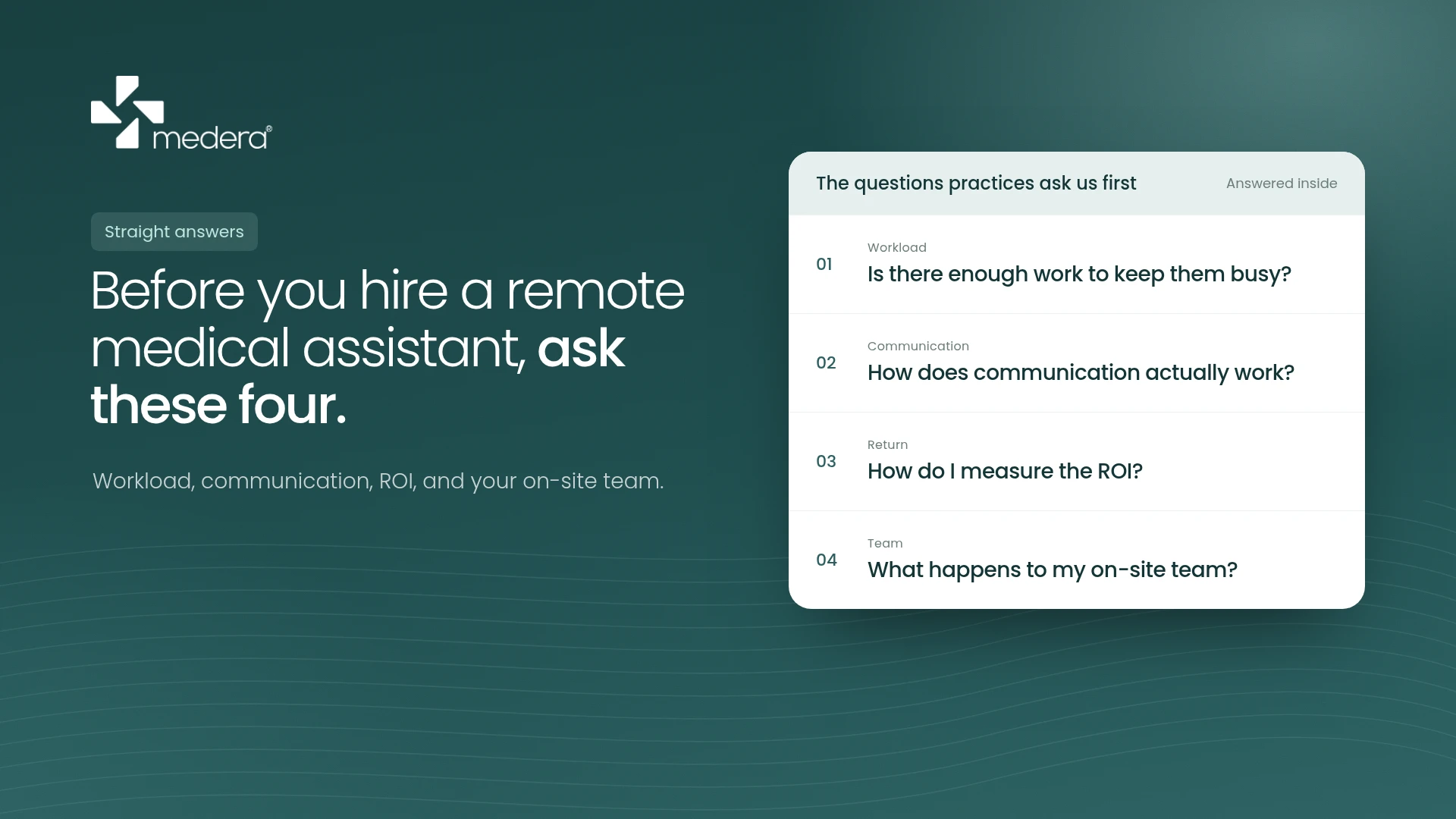
When practice managers consider remote support, these four questions come up. They're the right questions, so here are straight answers.
1. Is there enough workload to keep them busy?
Honestly, it depends on the practice, which is why we scope the work before anyone starts.
For most outpatient practices, though, the admin volume is bigger than it looks. The AMA's latest survey found that practices complete about 40 prior authorization requests per physician, per week, with physicians and their staff spending 13 hours each week on them. That's before inbound calls, reminders and recalls, referrals, faxes, refill requests, and eligibility checks.
For smaller practices, we don't force a full-time seat. We start part-time or build a blended role (calls in the morning and the back-office queue in the afternoon, for example), so there's always real work in the queue when the phones are quiet.
2. How does communication work between the VMA and the practice?
The EHR is the record. Anything clinical, such as refill requests, referral sign-offs, and lab orders, goes in as a task on the patient's chart, so there's a full audit trail.
Chat is the traffic controller. We set up channels by location and by task type: refills, controlled medications, referrals and prior auths, urgent prescriptions, and general questions. Your staff post in one place and the right person picks it up, with no phone tag or email chains.
Urgent items get escalated. If something is urgent, or a task sits untouched past an agreed time, the VMA pings the provider or supervisor in the right channel. The ping points them to the task queue; patient details stay in the EHR.
Mistakes get tracked. An escalations channel lets your managers flag anything we missed, and every correction is tracked and fed back into training.
We use whatever HIPAA-covered tool you already have (Microsoft Teams, Slack on a BAA-eligible plan, or your EHR's own messaging) and agree on escalation rules in writing before go-live.
3. How do I measure the ROI?
The same way you'd measure any hire: what it costs versus what it returns.
Cost. A full-time VMA runs about $14 an hour, roughly $2,500 a month. For comparison, the BLS median pay for an in-house medical assistant is $44,200 a year, or $21.25 an hour, before payroll taxes, benefits, PTO, recruiting, and turnover.
Returns fall into three buckets:
- Recovered revenue: rescheduled no-shows, booked overdue recalls, and backfilled cancellations. Count them and multiply by your average revenue per visit. An empty slot costs the same rent and staffing whether it's filled or not, so most of that revenue is margin.
- Protected revenue: authorizations filed and followed up on time, so procedures aren't delayed, cancelled, or denied.
- Staff time returned: hours your nurses and MAs stop spending on phones and paperwork, valued at their hourly cost.
ROI = (Returns − Cost) ÷ Cost.
For a quick break-even check, divide the monthly cost by your revenue per visit. At $100 a visit, that's about 25 recovered visits a month, just over one per working day.
We record your baseline before starting (no-show rate, missed calls, open authorizations, overtime) and report against it every month.
4. What happens to the on-site staff dynamic?
Honestly, this is the part that decides whether it works. Done badly, staff feel watched or replaced. Done well, it takes the work they least want off their plate.
A few things make the difference:
- A clear line. In-person and clinical work stays with your team. Remote-appropriate admin comes to us.
- Your staff design the handoffs. During onboarding, they decide what moves and how.
- One named on-site contact and a written escalation path, so nobody is guessing who owns what.
- Handoffs happen in your EHR's task system, where everyone can see them.
Expect a few weeks of adjustment while trust builds. The goal is simple: the MA who was answering phones between patients gets to actually be with the patient.
Have a question we didn't cover? Send it to info@medera.org, or visit medera.org
 September 25, 2026 · 5 min read